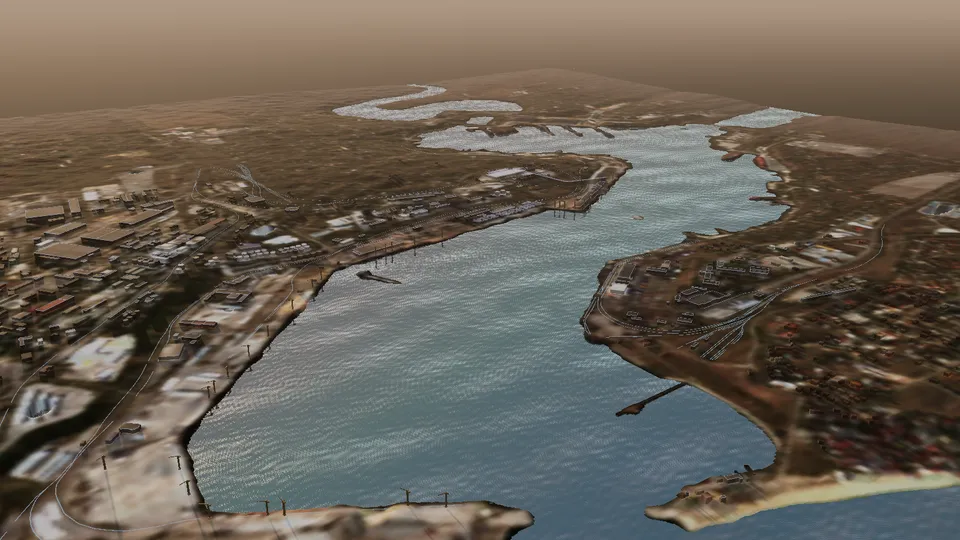
The grain harbour of Odesa in 3D: silos and quays along the empty harbour, from the Sentinel-2 image of 3 October 2026 and OpenStreetMap buildings

Odesa's grain harbour, 3 October 2026 · contains modified Copernicus Sentinel data 2026 · buildings © OpenStreetMap contributors

Case study · Black Sea · July–October 2026

The grain is trapped.
Not missing.

On 10 July 2026 Russia closed the Kerch Strait to commercial ships. Within weeks, foreign cargo ships stopped calling at Odesa and strikes halted Russia's grain terminals at Novorossiysk. For the first time in this war, both shores of the Black Sea are constrained at once. We followed the trade, the fuel, the food, and six of the ports from space.
Kerch Strait · Black Sea and Danube portsSentinel-1 · Sentinel-2Evidence to 15 October 2026
01 · What happened

A strait closed in an evening.

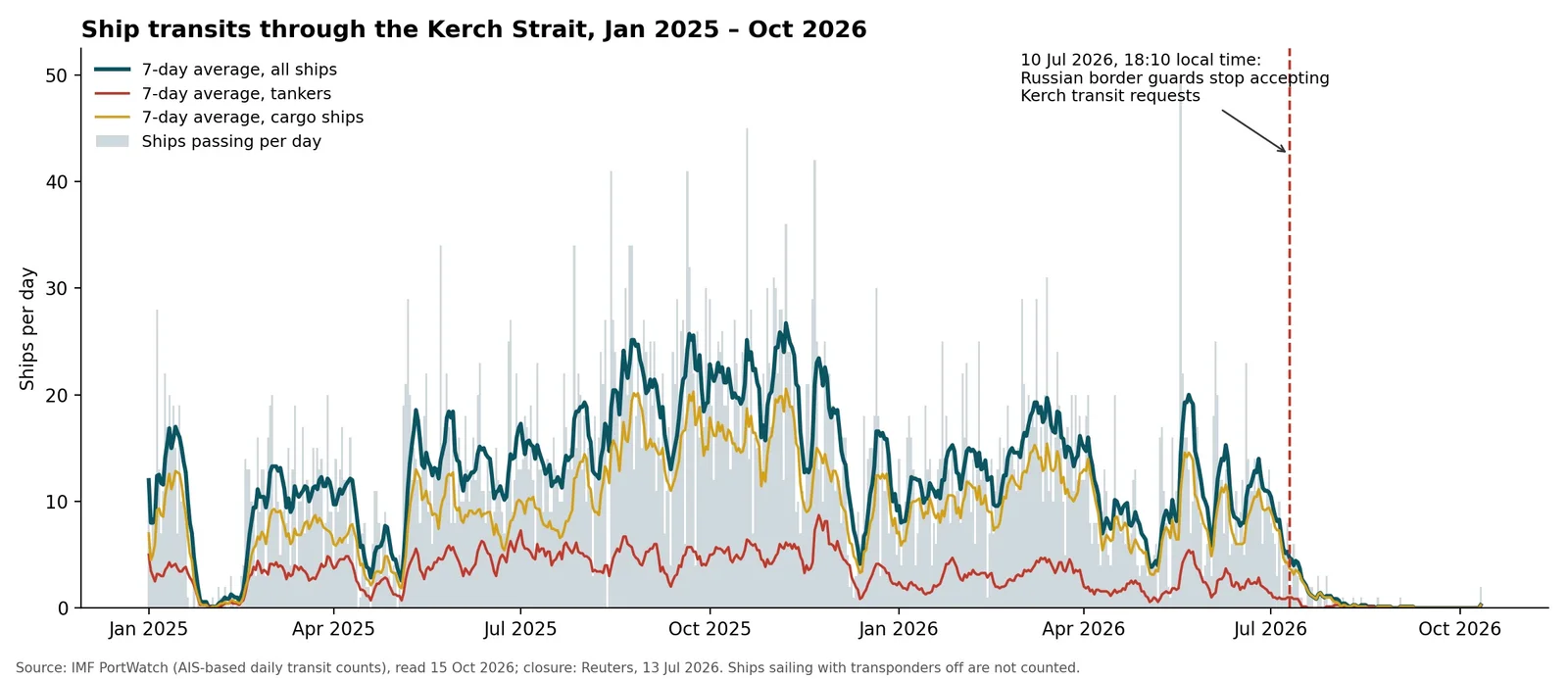
At 18:10 local time on 10 July, Russia's border service stopped accepting requests to pass the Kerch Strait. The order followed Ukrainian drone strikes on ships in the Sea of Azov. No Russian authority announced it. Ship-tracking data show traffic collapsing within a week.

1
ship through the strait in all of September

11 a day in June

37Mt
less grain shipped by Russia and Ukraine

next 12 months · range 16–55

$1.5bn
more for ten wheat importers

next 12 months · range 0.5–3.4

1.1–2.4M
more people in acute food insecurity

six countries with IPC data

≈5months
to June volumes after a ceasefire

Greater Odesa · range 3–12

Strait: IMF PortWatch. Exports, import bill, people and recovery: Watchfloor model, central case, October 2026 to September 2027. Hunger and recovery are model scenarios with low confidence, not observations or IPC projections.

Chart: ships through the Kerch Strait per day, about 14 a day on average in 2025 and 11 in June 2026, almost none after the 10 July closure
Kerch Strait transits. Source: IMF PortWatch. Ships sailing with transponders off are missed: zero means no visible commercial traffic.
02 · Trade, fuel and food

Cheap at the port. Dear on arrival.

The Sea of Azov ports handled a quarter to a third of Russia's seaborne wheat. Other routes, through the Baltic and the Caspian, so far replace about a quarter of what the south lost. Grain prices in southern Russia have roughly halved. Yet importers pay more.

≈ halved

Grain prices in southern Russia, by October. The grain cannot leave.

freight · war-risk insurance · longer routes
+$45–63 /t

Importers' wheat tender prices, against before the disruption; partly because world prices rose.

This is not a year of missing grain. World wheat stocks are about 276 million tonnes, and Turkey and Egypt harvested record crops. The grain is stranded behind the Black Sea. On fuel, the closure's own effect is mostly local: the 2026 diesel spike comes from lost Gulf exports and damage to Russian refineries.

03 · Who pays

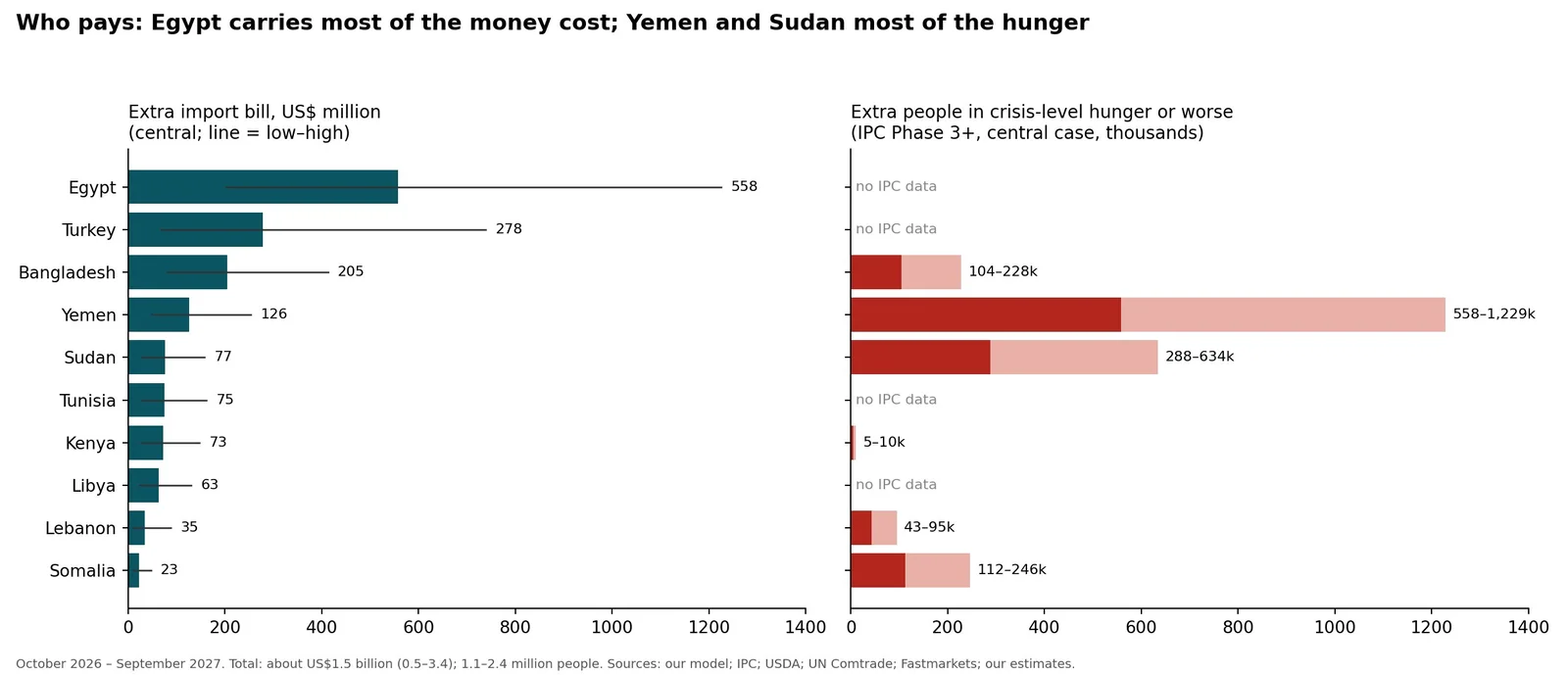
Egypt pays in money. Yemen and Sudan in hunger.

For ten importers that depend on Black Sea wheat, the extra bill over the next twelve months is about US$1.5 billion. Egypt pays the most, but its fixed-price bread subsidy shields consumers. Countries that buy at market prices, with no buffer, pay in hunger. Humanitarian food assistance pays too: about US$20 million more for cereals, a year of rations for about 310,000 people.

Chart: extra import bill by country, Egypt highest, and extra people in crisis-level hunger, Yemen and Sudan highest
Central case, October 2026 to September 2027. Hunger: dark is the low end of the range, pale the high end. Sources: Watchfloor model; IPC; USDA; UN Comtrade; Fastmarkets; our estimates.
Model scenario · low confidence · not an IPC projection
04 · The ports from space

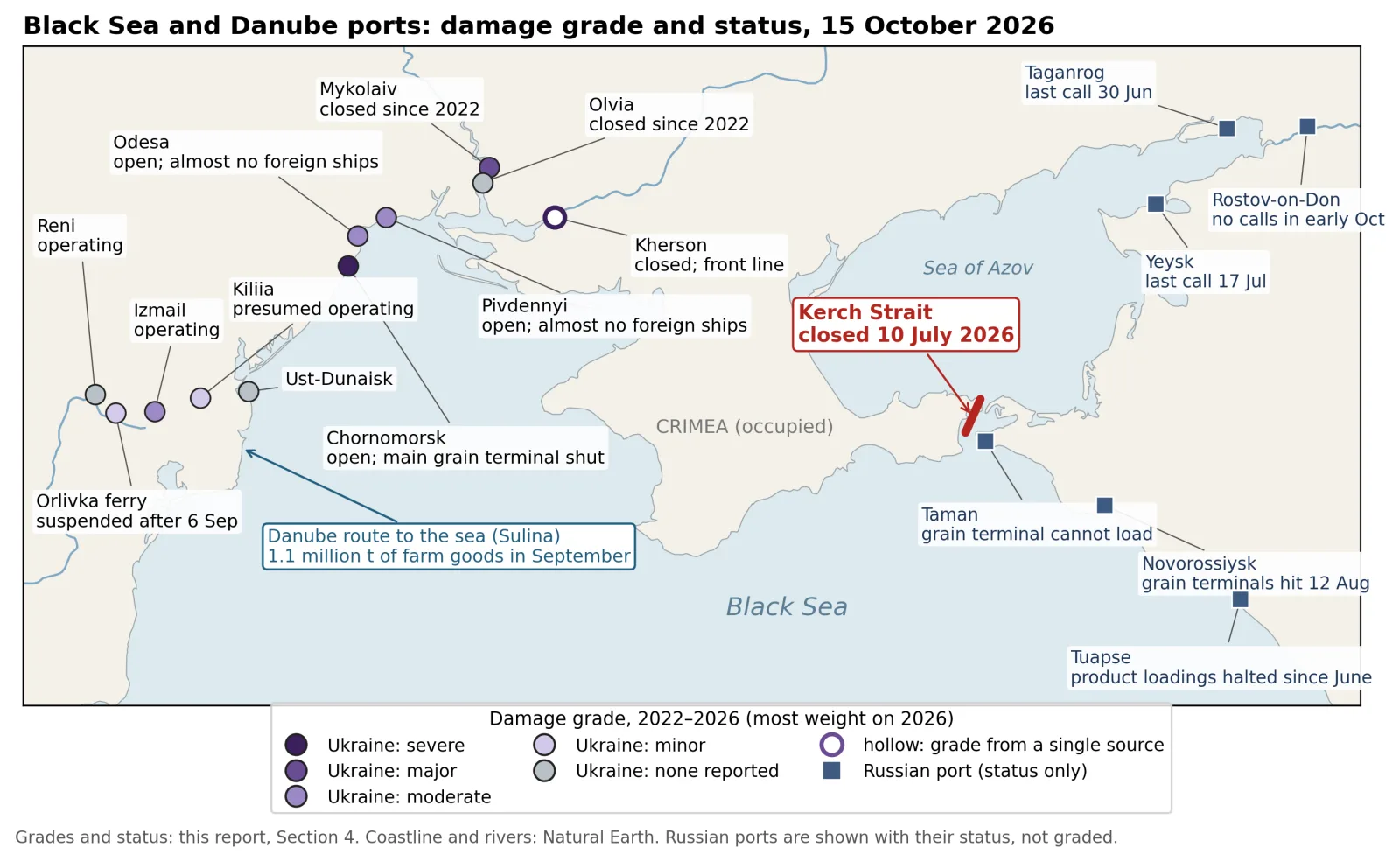
Serious damage, concentrated in a few terminals.

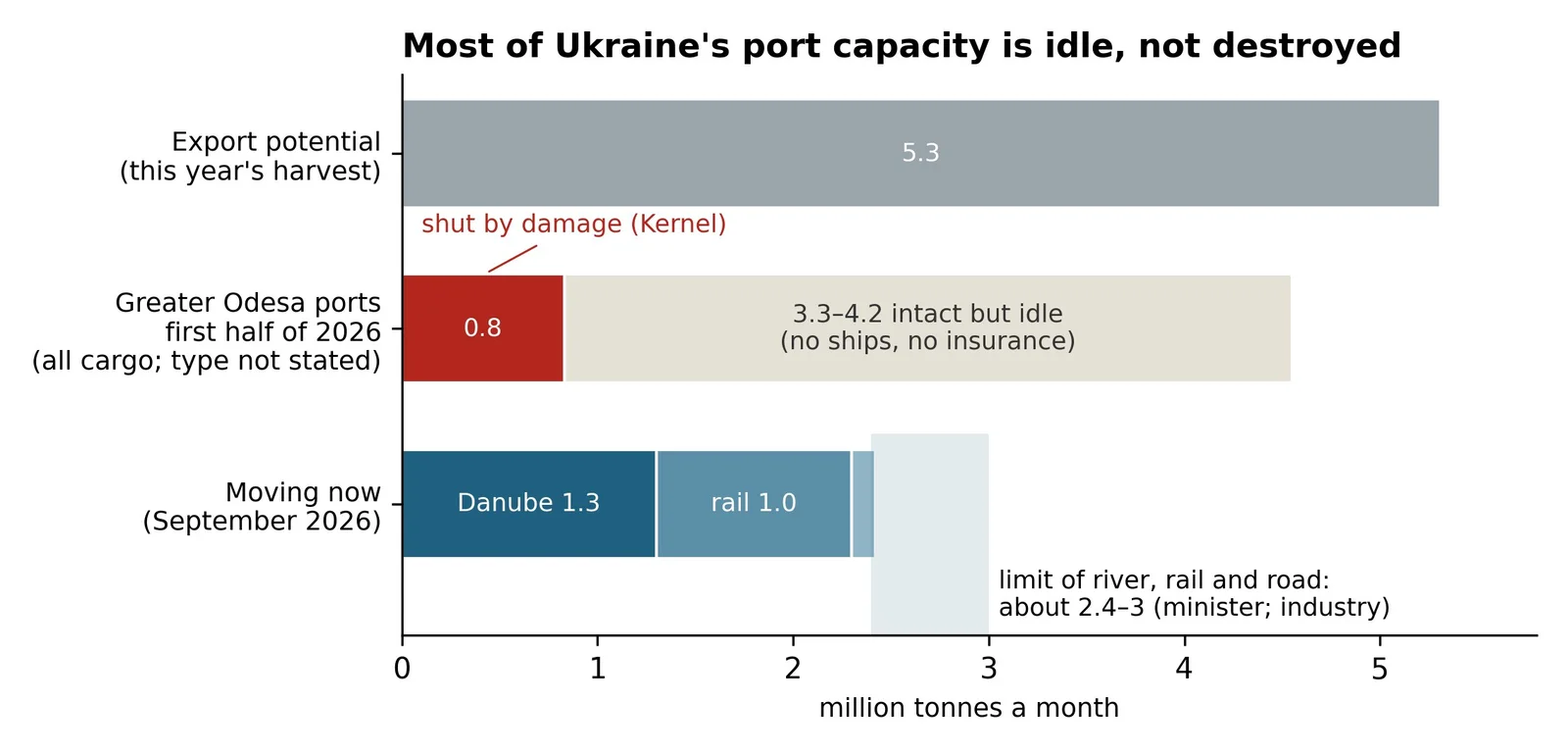
Physical damage has shut Kernel's grain terminal at Chornomorsk, about 0.8 million tonnes a month. Most of Greater Odesa's capacity is intact but idle: foreign ships and insurers have stayed away since 20–22 July. The Danube ports still work, and with rail and road they now carry almost all of Ukraine's exports.

Map of the Black Sea and Danube ports by damage grade and status on 15 October 2026, with the Kerch Strait closed since 10 July
Damage grade 2022–2026, most weight on 2026, kept separate from whether ships call. Russian ports: status only. Coastline and rivers: Natural Earth.
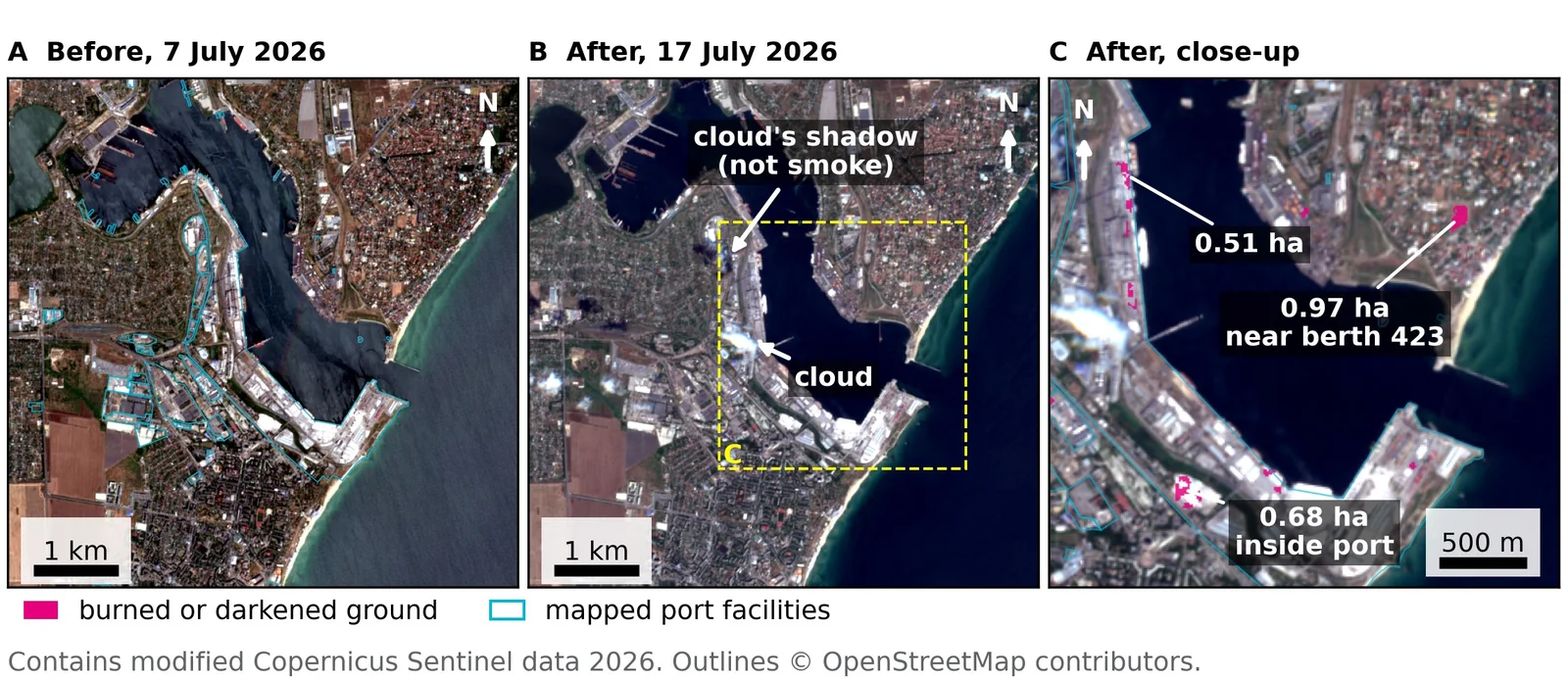
4.2 ha
Chornomorsk · against 0.8 ha in a period with no confirmed strike

Burned or darkened ground after the July strikes, about 3 ha of it inside the port, seen by Sentinel-2.

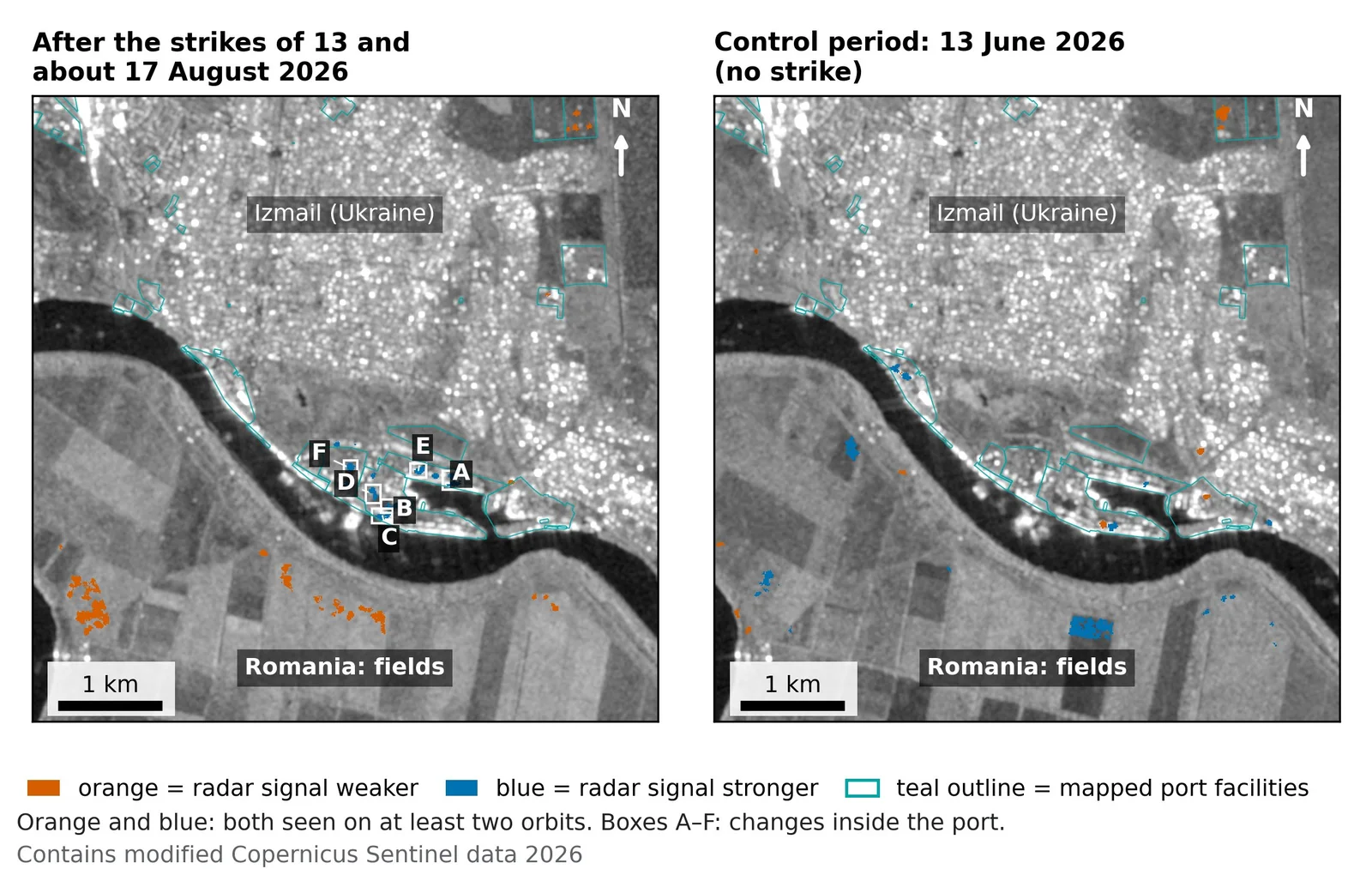
4.7 ha
Izmail port · against 1.4 typical, 3.6 at most

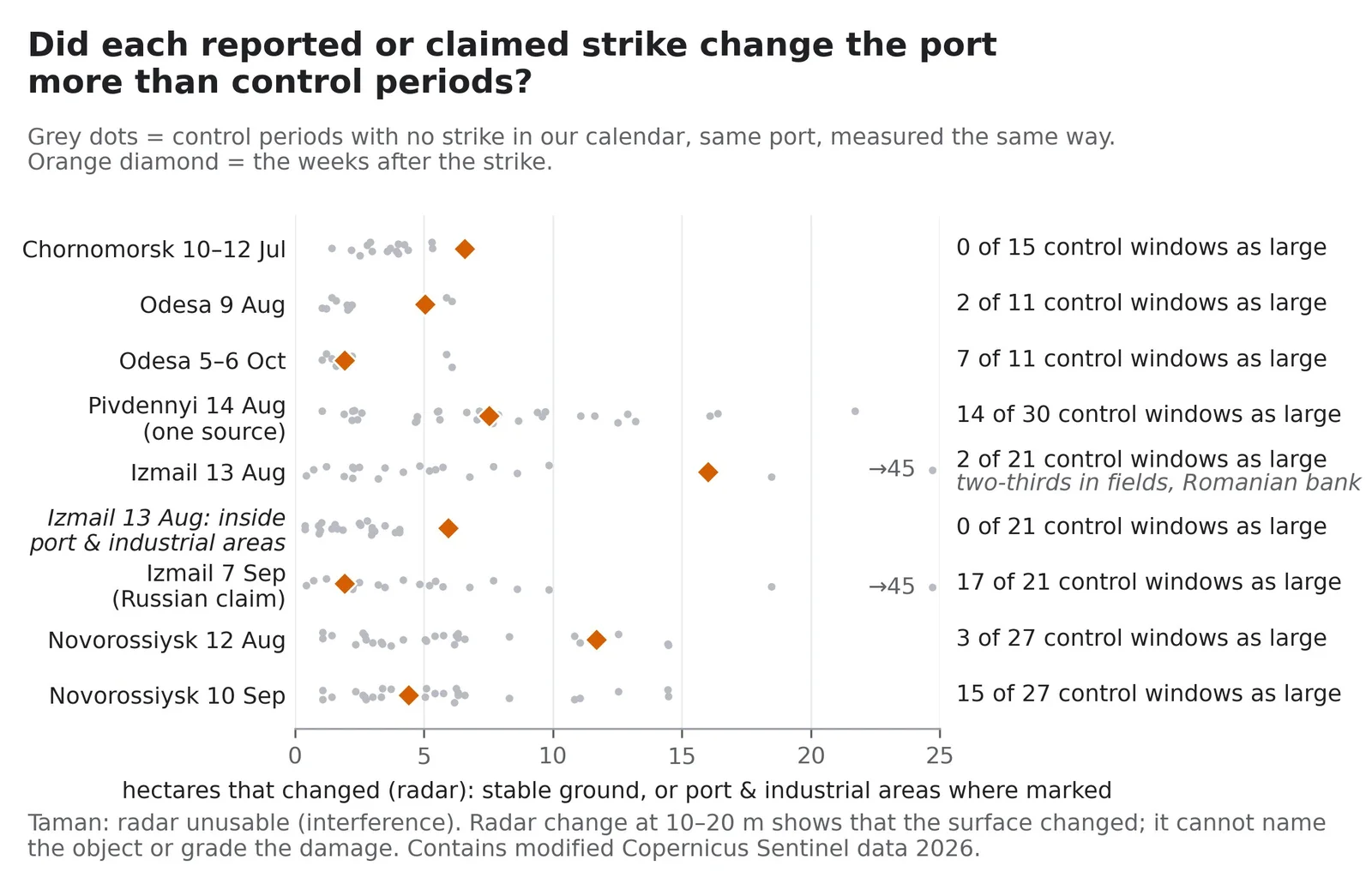
Radar change inside the mapped port after the August strikes. Larger than in any of 21 normal periods with no strike.

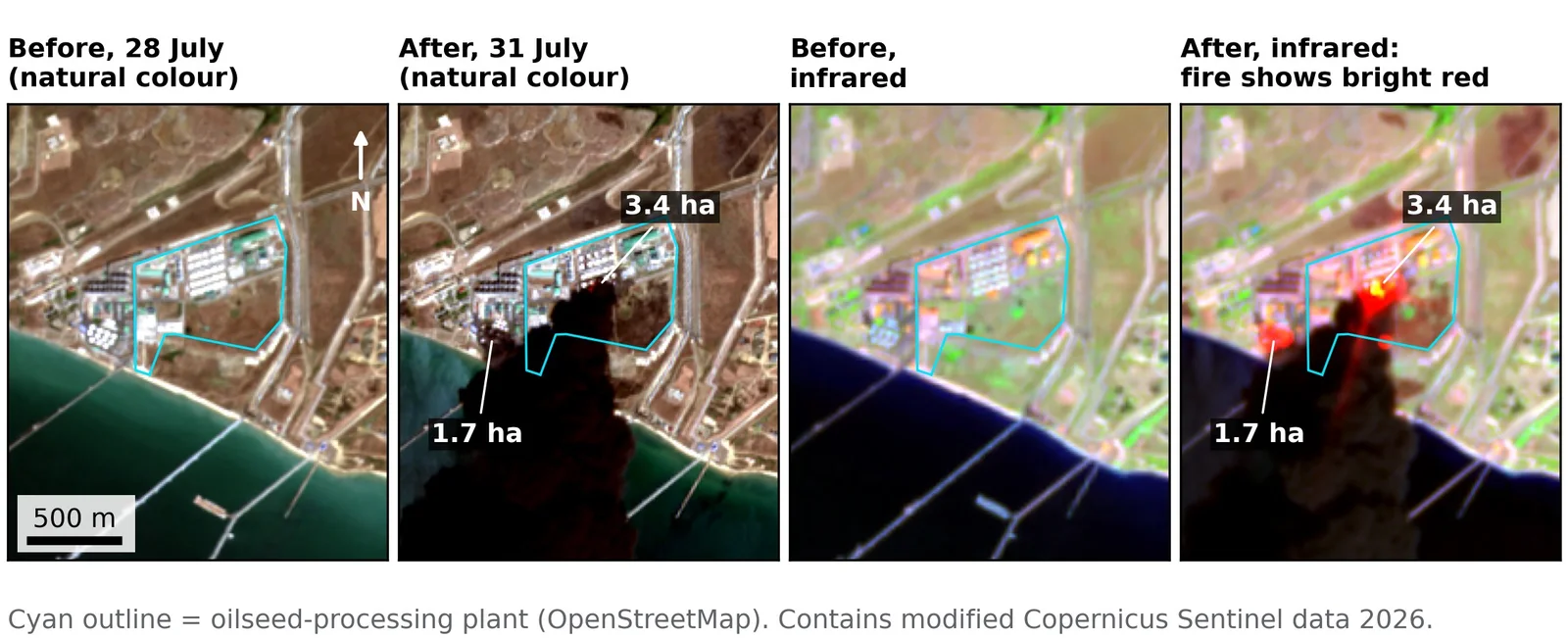
3.4 ha
Taman · 31 July

Fire inside the outline of an oilseed-processing plant, one day after the reported strike.

Chornomorsk on 7 and 17 July 2026: burned or darkened ground marked in magenta inside the port
Chornomorsk, 7 and 17 July 2026. Contains modified Copernicus Sentinel data 2026. Outlines © OpenStreetMap contributors.
Izmail radar change after the August strikes against a normal period with no strike
Izmail, radar change after the August strikes (left) and in a normal period with no strike (right). Contains modified Copernicus Sentinel data 2026.
Taman on 28 and 31 July 2026: a terminal fire seen by Sentinel-2
Taman, 28 and 31 July 2026. Contains modified Copernicus Sentinel data 2026.
Chart: radar change after each reported or claimed strike, compared with normal periods with no strike, port by port
Each reported or claimed strike, compared with normal periods when no strike was reported. Radar shows that a surface changed; it cannot name the object or grade the damage.
Chart: Ukraine's export capacity, 0.8 million tonnes a month shut by damage, 3.3 to 4.2 intact but idle, about 2.4 moving by Danube, rail and road
Million tonnes a month. Greater Odesa: all cargo, first half of 2026. Moving now: September 2026.
05 · The ports in 3D

Fly the Black Sea. Walk the ports.

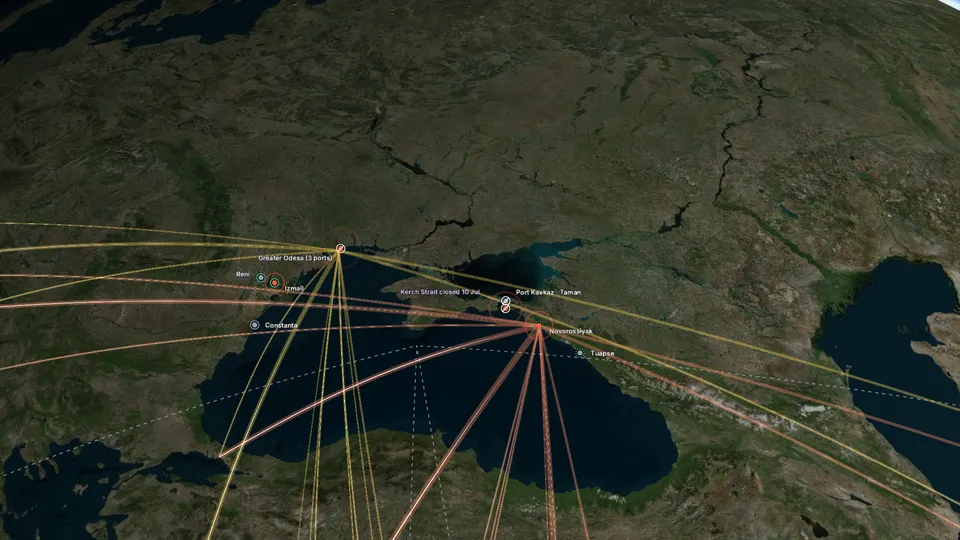
Every strike report dated and linked to its source, satellite photos before and after, and the trade that depends on each port. Follow the tour stop by stop, or explore on your own.

Globe: contains modified Copernicus Sentinel data 2026 · terrain, Bing imagery and Google Photorealistic 3D Tiles via Cesium ion · © OpenStreetMap contributors. Ports: Sentinel-2 photos, OpenStreetMap buildings and relief; the sharper photo is Esri World Imagery, for shapes, not for damage. Best on a computer; on a phone, the tour works with a tap.

06 · If the war ended today

First ships in weeks. The full network outside the occupied ports in about three years.

Insurance and shipowners' confidence set the pace, not the cranes. The 2022 grain deal moved its first ship ten days after signing. A ceasefire now would bring the import bill down to about US$0.5–0.7 billion.

Step after a ceasefireMonths: central (range)What sets the pace
Kerch Strait reopensdaysA Russian administrative order
First ships move0.5 (0.25–3)Power at berths, corridor lanes re-checked
Insurance at corridor rates1.5 (0.5–4)A government-backed scheme, as in 2023
Sea of Azov trafficabout 1 (days–4)Strikes stop, wrecks checked; Don river traffic from spring
Greater Odesa back to June volumes5 (3–12)Ships and charters returning; Kernel's Chornomorsk terminal is the main repair
Mykolaiv and Olvia reopenalmost a quarter of seaport cargo in 202112 (6–24)The channel past the Kinburn Spit secured and cleared
Full pre-2022 networkoutside the occupied ports36 (24–60)Rebuilding Kherson; insurers' war-risk list lifted
Watchfloor estimates for a ceasefire on 15 October 2026 · low confidence
07 · What to do

Five points for planners and donors.

Plan for the closure to last.Through September 2027 in the central case. Size import support and humanitarian pipelines on these figures, with room for the high case.
Protect the buyers with no buffer.Yemen, Sudan, Somalia and Lebanon pay market prices. Pre-finance their wheat and humanitarian cereals before the January–March tenders.
Keep the Danube open.Protect Izmail, Reni and the route through Sulina and Constanța, and restore the barge capacity cut by this summer's low water.
Fund the extra cost of humanitarian cereals.About US$20 million in the central case: a year of cereal rations for about 310,000 people.
Prepare the restart now.A state-backed war-risk facility ready from day one would shorten the five months to June volumes.
08 · The report

35 pages, 116 sources.

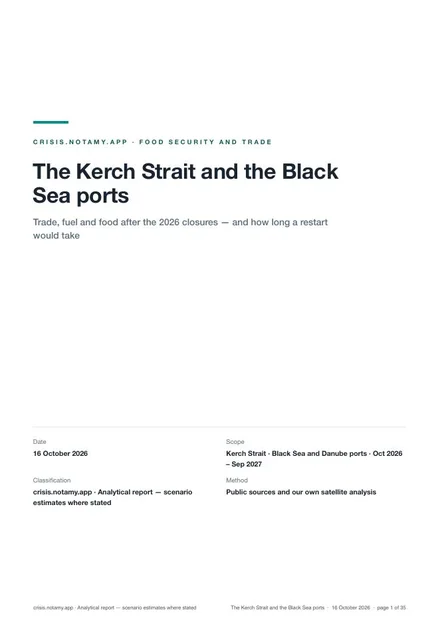
Cover of the report: The Kerch Strait and the Black Sea ports

The Kerch Strait and the Black Sea ports: trade, fuel and food after the 2026 closures, and how long a restart would take. Port by port, with every satellite measurement set against normal periods when no strike was reported, the model's central case and range, and the signals that would move the numbers.

09 · What this cannot tell

The limits, said plainly.

Satellite images at 10 metres see fires, burn scars and changes in the ground surface, not damaged cranes, conveyors or silos: a port without a signal is not proof of a port without damage. Ship-tracking misses vessels with transponders off. Strike reports are kept in three kinds: confirmed, single source, and claims; a claim is never counted as a fact. Hunger, import bills and recovery times are model scenarios with low confidence, not observations.

Watchfloor

From a closed strait to the people who pay for it.

Every analysis starts from a multi-source gather: ship tracking, satellite imagery, markets, food-security data and our own measurements. Ask for one on the crisis you follow.

Sources: IMF PortWatch (Kerch Strait transits, Suez) · Reuters · Ukrainian Sea Ports Authority · Ukraine's Ministry of Agrarian Policy · USDA · AMIS · FAO · IEA · International Grains Council · S&P Global · SovEcon · IKAR · Kyiv School of Economics · CSIS · Council on Foreign Relations · IPC · UN Comtrade · Fastmarkets · contains modified Copernicus Sentinel data 2026 (Sentinel-1 and Sentinel-2) · buildings, port outlines and places © OpenStreetMap contributors, ODbL · coastline and rivers: Natural Earth. Full references (116) in the report. Model, measurements and charts: Watchfloor.